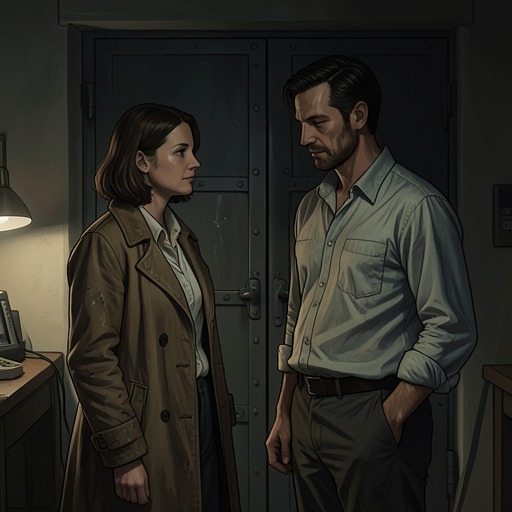
Irene Takes Fin to Belgium for Training
Gente que viene y ¡Bah!Irene’s decision to move with Fin to Bélgica turns his unnamed dread of death into a practical family choice: he wants to keep racing, and pursuing that ambition requires a parent to go with him. The plan emerges when Teo helps Fin explain the anxiety he had been hiding, and Ángela’s note gives Irene a final, direct reminder to hear what her son needs.
The fear beneath the announcement
The decision follows a conversation that had lasted for hours. Fin was reluctant to explain what was wrong, and Teo offered to speak for him. Fin nodded. Through Teo’s account, the family learns that Fin’s overwhelming fear of death has a specific source: he wants to continue competing on his motorcycle, improve, and become the best, but that ambition requires training beyond what is available to him at home.
The obstacle is not simply distance. The strongest training opportunity is with a team in Bélgica, and because Fin is a minor, he would have to move with one of his parents. His father was not an option because he had never approved of Fin’s passion for racing. Irene had also seemed unavailable: until then, she had devoted herself completely to her work as mayor. The future Fin wanted therefore appeared blocked by circumstances he could not easily change.
Teo explains that Fin had not consciously framed his distress as frustration with his circumstances. Rather than blame anyone for what he feared might be bad luck, Fin had withdrawn and become progressively more anxious. Unable to find a solution to the concrete problem, he had buried it beneath a larger, more absolute fear: dying. In Teo’s interpretation, that fear also meant fearing that he would never get to live the life he wanted. The disclosure changes the family’s understanding of Fin’s distress from an abstract preoccupation with death to anxiety bound up with his ambitions and dependence on adult support.
Bea’s narration emphasizes the clarity of Teo’s explanation. She regards his grasp of Fin’s inner life as striking and recognizes, with self-reproach, that the family had failed to understand what was happening. Her aside that Teo would make a good psychologist, and a wonderful father to Óscar, places his insight within the family’s view of him while underlining how unexpectedly well he has articulated Fin’s needs.
Irene makes the plan concrete
After Teo has explained the problem, Irene tells the family that she and Fin have decided to try their luck in Bélgica, where Fin can train with the best team in the world. The announcement turns an emotional explanation into a specific course of action. They plan to leave in a month; this passage establishes the decision and its timetable, rather than describing their arrival or the training itself.
Irene has already begun studying Dutch. For the immediate task of finding work as a lawyer, she expects to manage with English. These details show that the move is not merely an expression of support: she is preparing for its practical demands and anticipating the need to establish herself in another country. The evidence does not say that she has found a job or settled the move’s other arrangements, only that she has begun taking steps toward it.
Irene also asks whether their father would object to their going. He readily gives his approval, saying he wants to see his grandson win the world championship. Fin jokes that his grandfather is applying pressure from the outset. The exchange combines encouragement with a light acknowledgement of the expectations that can accompany competitive ambition: Fin’s goal has gained family backing, but it is still framed in terms of winning at the highest level.
Ángela’s note and the meaning of the choice
Bea then connects Irene’s decision to a note their mother had left for her. With Irene’s agreement, Bea reads Ángela’s message aloud: it urges Irene to listen to her son, recognizes Fin as both a champion on his motorcycle and an exceptionally good and clever teenager, and reminds her that he still needs her more than she realizes. Irene responds by acknowledging how perceptive her mother had been.
The note does not introduce a new plan; it clarifies the emotional significance of the one Irene has already chosen. Fin’s need is presented as more than the logistical requirement that a minor travel with a parent. Ángela’s words ask Irene to recognize the dependence beneath her son’s ambition and distress. Set beside Irene’s previous commitment to the mayoralty, the decision marks a change in where she is prepared to direct her attention, without the passage specifying what becomes of her public office.
The scene also gives the move a place in the family’s reading of Ángela’s remaining notes. Bea understands her mother’s message as an explanation for Irene’s choice, and Irene receives it as confirmation of her mother’s insight. As Bea prepares to read another note, the account shifts toward that next act of remembrance; the Bélgica decision stands as a concrete instance of the family trying to hear and answer one another while Ángela’s words remain present among them.